
When choosing an LED display solution, one of the most common questions is whether to use a flexible LED screen or a rigid LED screen.
Although both technologies use LED pixels to display images and video, they differ significantly in structure, application, and design flexibility.
This article explains the key differences to help designers, system integrators, and project owners make the right choice.
What Is a Flexible LED Screen?
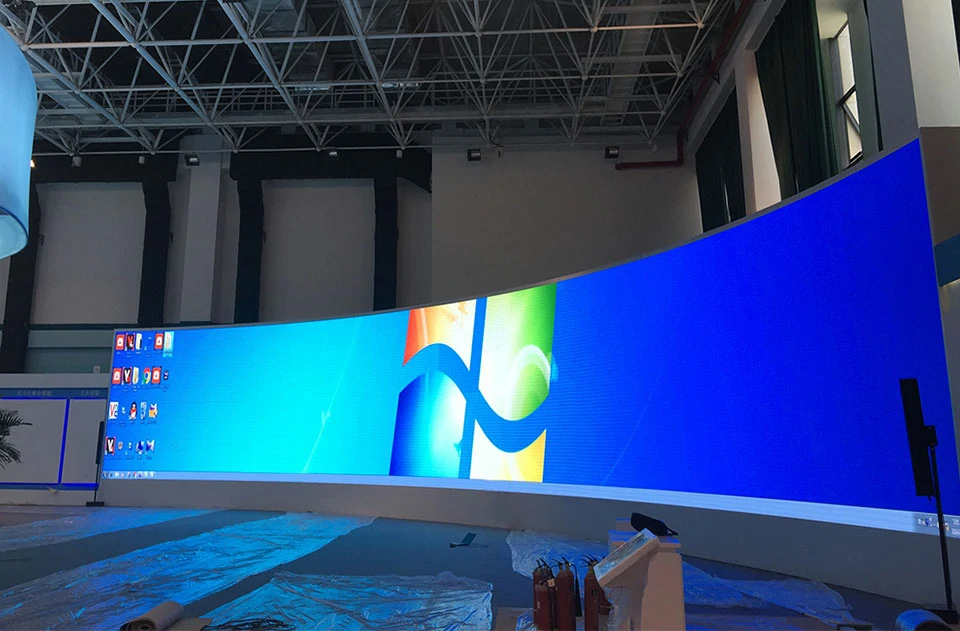
에이 flexible LED screen is built with soft PCB LED modules that can bend, curve, or wrap around non-flat surfaces.
It is mainly used for creative and architectural installations where traditional flat panels cannot fit.
Typical applications include curved walls, cylindrical columns, wave-shaped displays, and custom artistic structures.

What Is a Rigid LED Screen?
에이 rigid LED screen uses hard aluminum or steel cabinets with fixed LED modules.
It is designed for flat installations such as standard video walls, conference rooms, control centers, and outdoor advertising screens.
Rigid LED displays are widely used due to their stability, scalability, and cost efficiency.

Flexible vs Rigid LED Screen: Core Differences
1. Structural Design
Flexible LED Screen:
Soft PCB structure, bendable and adaptable to irregular shapes.Rigid LED Screen:
Fixed cabinet structure, designed only for flat surfaces.
2. Installation Flexibility
Flexible LED Screen:
Supports convex, concave, cylindrical, and custom-shaped installations.Rigid LED Screen:
Limited to flat walls or standard angles.
3. Visual Effect
Flexible LED Screen:
Seamless curves and immersive visuals, ideal for creative displays.Rigid LED Screen:
Sharp and stable images on flat surfaces, suitable for information display.
4. Application Scenarios
Flexible LED Screen Applications:
Retail flagship stores
Museums and exhibition halls
Architectural feature walls
Creative brand experience spaces
Rigid LED Screen Applications:
Conference rooms
Control rooms
Advertising billboards
Indoor and outdoor video walls
5. Cost Considerations
Flexible LED Screen:
Higher cost due to customized design and flexible materials.Rigid LED Screen:
More cost-effective for large-scale flat installations.
Which LED Screen Should You Choose?
Choose a flexible LED screen if your project requires:
Curved or irregular surfaces
Creative visual design
High-impact brand presentation
Choose a rigid LED screen if your project focuses on:
Flat installation surfaces
Cost efficiency
Standard display requirements
The decision should be based on installation environment, design goals, and budget, not just technology preference.
LEDCOMS Professional Recommendation
From LEDCOMS project experience, flexible LED screens are best suited for high-end commercial and architectural projects, while rigid LED screens remain the most practical solution for standard display applications.
Many large projects even combine both technologies to achieve the best balance between creativity and cost control.
Get Expert Advice on LED Display Solutions
If you are unsure which LED screen type fits your project, LEDCOMS provides professional consultation and customized LED display solutions.
Our team can help you choose the right LED screen based on your application, environment, and performance requirements.


