
A Practical Solution Guide for Seamless Architectural Displays
Curved walls and columns are common in modern architecture, but they are also one of the most challenging surfaces for LED display installation.
Standard rigid LED cabinets often create visible gaps, uneven joints, or structural compromises when forced onto curved surfaces.
This page explains how flexible LED displays solve these problems, when they are the right solution, and how to design a curved or column LED display that is visually seamless and structurally reliable.
A flexible LED display is the most effective solution for curved walls and cylindrical columns because it can conform to continuous curves without visible gaps or forced panel alignment.
For architectural LED projects involving columns, arcs, waves, or irregular surfaces, flexible LED panels typically provide:
Better visual continuity
Lower structural complexity
More design freedom than rigid LED cabinets
Why Curved Walls and Columns Are Difficult for Traditional LED Screens
Traditional LED displays are built with rigid rectangular cabinets.
When applied to curved surfaces, they often cause:
Visible seams between panels
Inconsistent curvature
Increased custom metal structure costs
Visual distortion at viewing angles
For columns, the problem is even more obvious: rigid cabinets can only approximate a curve using many small flat segments — never a true cylinder.

How Flexible LED Displays Solve These Challenges
Flexible LED displays use bendable LED modules that adapt directly to the surface curvature.
Key advantages for curved and column installations:
True curvature (inward or outward)
Seamless visual appearance
Uniform pixel alignment
Custom-fit installation structures
Instead of forcing the architecture to fit the screen, the screen is designed to fit the architecture.
Typical Applications for Curved & Column Flexible LED Displays
1. LED Displays for Architectural Columns
Flexible LED panels wrap smoothly around:
Round columns
Oval or irregular pillars
Load-bearing architectural elements
They are commonly used in:
Winkelcentra
Airports
Hotel lobbies
Corporate headquarters
2. Curved LED Walls in Commercial Spaces
Curved walls are popular in:
Retail flagship stores
Brand experience centers
Museums and galleries
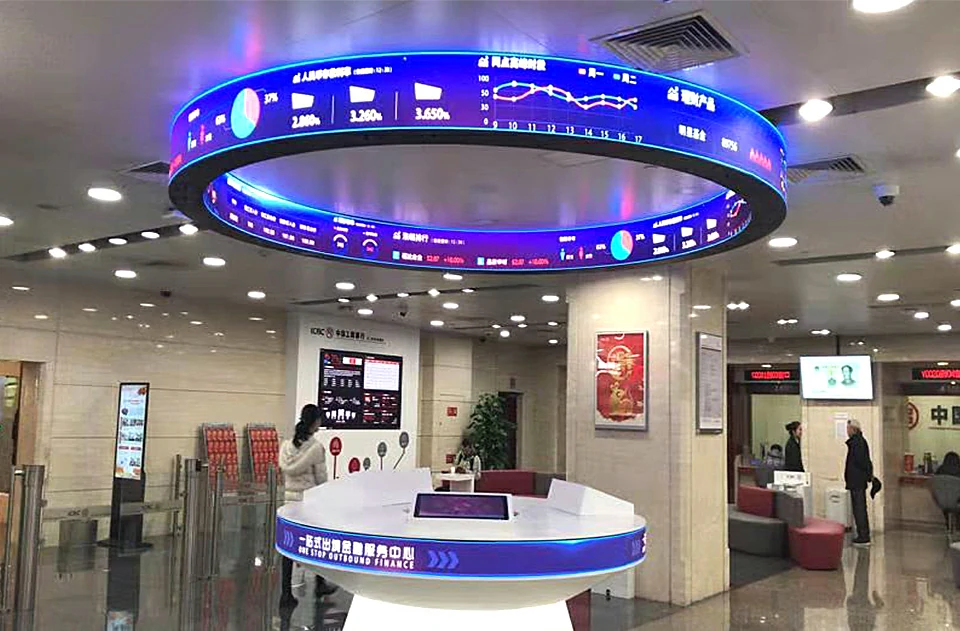
Flexible LED displays allow designers to create continuous visual surfaces without segmentation.
3. Creative Feature Walls and Atriums
In large open spaces, curved LED walls act as architectural features, not just digital signage.
Key Design Considerations for Curved & Column LED Displays
1. Curvature Radius (Critical)
Every flexible LED module has a safe bending radius.
Design must confirm:
Minimum curvature radius
Inward vs outward bending limits
Stress distribution across modules
Exceeding limits can shorten lifespan or cause pixel failure.
2. Pixel Pitch Selection
For most curved wall and column applications:
P1.8 – P3 is common for close indoor viewing
P3 – P4 works well for larger spaces
Choosing ultra-fine pitch increases cost but often provides no visible benefit at typical viewing distances.
3. Viewing Angle and Content
Curved displays naturally offer wider viewing angles, but:
Content design must account for curvature
Text size and contrast matter more than raw resolution
4. Installation Structure
Flexible LED displays require custom mounting frames, typically designed together with the LED system.
Well-designed structures:
Maintain consistent curvature
Reduce module stress
Improve long-term reliability
Flexible LED vs Curved Cabinet LED: Which Is Better?
| Aspect | Flexible LED Display | Curved Cabinet LED |
|---|---|---|
| Curvature flexibility | Continuous | Fixed angles |
| Column suitability | Excellent | Limited |
| Seam visibility | Minimal | Often visible |
| Custom shapes | Easy | Restricted |
| Structural complexity | Lower | Higher |
Key takeaway:
For true curves and columns, flexible LED is usually the more practical and visually superior solution.

Common Mistakes in Curved & Column LED Projects
Forcing rigid cabinets onto curved surfaces
Ignoring module bending limits
Choosing pixel pitch without considering viewing distance
Treating flexible LED as a standard product instead of a custom solution
Avoiding these mistakes significantly improves project outcome.
Cost Perspective: Is Flexible LED Worth It?
Flexible LED displays typically have a higher unit price than standard flat LED cabinets.
However, for curved walls and columns, they often reduce total project cost by minimizing:
Custom metal cabinet fabrication
Complex structural modifications
Visual rework and alignment issues
The correct comparison is total installed cost, not material price alone.
How Flexible LED Solutions for Curved Structures Are Typically Designed
Professional LED engineers generally follow this workflow:
Analyze architectural drawings and curvature
Define viewing distance and content type
Select suitable pixel pitch and module type
Confirm curvature radius and mechanical limits
Design mounting structure and installation method
Perform calibration and stress testing
At LEDCOMS, flexible LED solutions for curved walls and columns are engineered as complete systems, ensuring visual consistency and long-term stability rather than just supplying panels.
Is a Flexible LED Display Right for Your Curved Wall or Column?
Flexible LED is a strong choice if:
Your surface is curved or cylindrical
Seamless appearance is required
Architectural integration matters
Custom design is preferred over standardization
If the surface is flat or budget-driven, a traditional LED wall may be more appropriate.
Final Recommendation
For curved walls and columns, flexible LED displays offer the most natural, seamless, and architecturally aligned solution.
Success depends not only on the LED panels themselves, but on proper design, curvature control, and installation engineering.
Planning a Curved Wall or Column LED Project?
If you are designing an LED display for a curved wall or architectural column and want an engineer-backed solution,
the team at LEDCOMS can help you evaluate:
Curvature feasibility
Pixel pitch and viewing distance
Structural and installation requirements
Talk to an LED engineer and get a flexible LED solution tailored to your architecture.


